
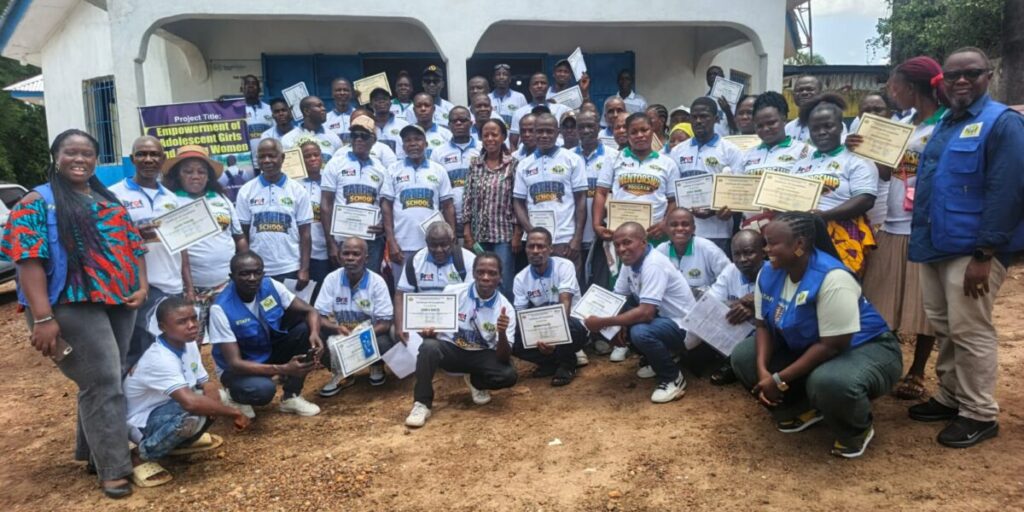
In the rural communities of Montserrado, Margibi and Bong counties, a quiet but powerful shift is taking place. Fathers who once viewed girls’ education as less important than boys’ are beginning to challenge long-held beliefs, support their daughters’ ambitions and advocate for their right to learn.
The change is being driven through Father School sessions implemented by the Center for Justice and Peace Studies (CJPS) as part of the Empowerment of Adolescent Girls and Young Women project, supported by Bread for the World.
The initiative brought together 180 fathers, aged between 22 and over 60, in a series of structured learning and dialogue sessions designed to address harmful gender norms and stereotypes. Working in groups of 15, participants engaged in discussions on parenting, gender equality, girls’ rights and the role fathers can play in creating safer, more supportive environments for adolescent girls and young women.
For many participants, the sessions became more than a learning opportunity. They offered a rare space for reflection, honest conversation and peer support.
Drawing on modules developed by CJPS, fathers explored how traditional gender expectations shape decisions within households and communities. They shared personal experiences, exchanged practical solutions and learned from one another’s journeys. For those who struggled to adopt new perspectives, support groups were established to provide ongoing mentorship and encouragement.
A shift inside the home
The impact of these conversations is already being felt within families. Fathers who completed the programme reported significant changes in their attitudes and decision-making, improved relationships at home, reduced family tensions and a greater willingness to listen to their daughters.
For Samuel, a father of five from Margibi, the change has been fundamental. He describes how he used to respond to disagreements with his wife and daughters with anger and, at times, violence.
“I no longer fight my wife, nor do I speak to my daughters aggressively. This is due to the counsel and education I received from this programme. Now I am more involved in my daughters’ education, and I provide equal support to all my children, before, the boys were given more privileges. I hope it continues so that other men with a similar mindset can learn and change.”
The effects have not gone unnoticed by his children. His daughter, aged 16, describes the moment things began to shift:
“We noticed a sudden change in our father’s attitude after his participation in a few Father School sessions held near our home. It was shocking to hear him asking about our schoolwork. It was even more astonishing when he attended a Parents-Teachers Association meeting for the first time. He now helps our mother prepare food, care for our younger siblings and do chores at home. Is this a dream? I am still thinking.”
Participants also reported a deeper understanding of the risks girls face, including violence, exploitation and abuse. Through the programme, fathers gained the knowledge and confidence to identify harmful practices, challenge them and support girls in seeking help when needed.
The context these fathers are working against
These changes are particularly significant given the barriers adolescent girls and young women continue to face across Margibi, Bong and Rural Montserrado counties. Deeply rooted gender norms limit opportunities for girls, while harmful practices including child marriage, female genital mutilation and gender-based violence remain prevalent in communities where cultural expectations often prioritise boys’ education and assign girls domestic responsibilities from an early age.
Poverty, teenage pregnancy, limited access to healthcare and inadequate school infrastructure further compounds these challenges. Many girls are forced to leave school before completing their education, reinforcing cycles of poverty and inequality. Recent economic pressures, including the lasting effects of COVID-19 and reductions in international development funding, have made these challenges more severe, increasing the number of children out of school.
Fathers as partners in change
Recognising that lasting change requires the involvement of men and boys, the Father School initiative places fathers at the centre of efforts to advance gender equality. By challenging harmful beliefs and promoting positive parenting practices, the programme is helping to create households where girls are supported, protected and encouraged to succeed.
The results are promising. Ninety-one percent of participating fathers completed the programme and are now actively supporting girls’ education in their communities. Many have become advocates for change, encouraging other parents to invest in their daughters’ futures.
For the girls whose lives are being shaped by these shifting attitudes, the impact extends far beyond the classroom. It is opening pathways to greater confidence, opportunity and choice, and laying the foundation for stronger families and more equitable communities.


