
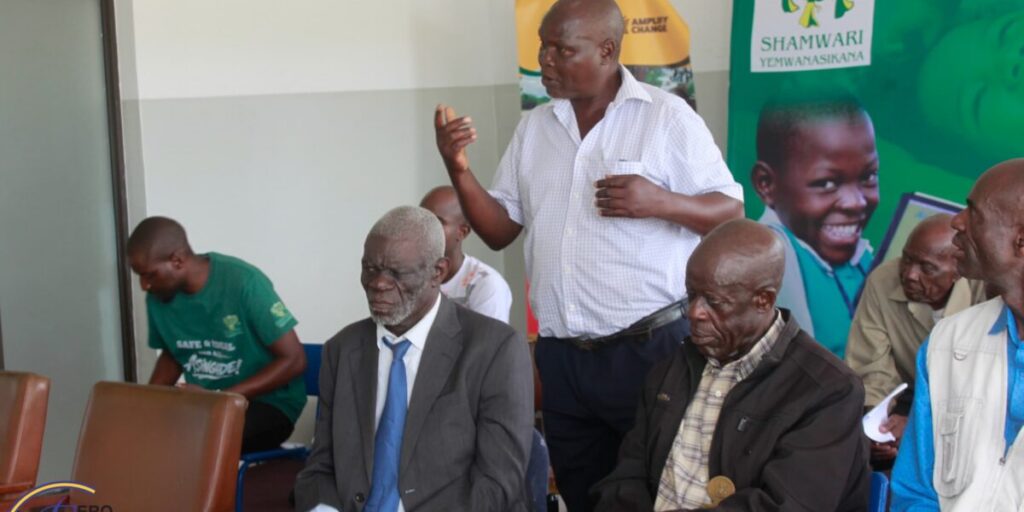
In rural Zimbabwe, the Dare RaMambo, the Chief’s Council, has for centuries been the exclusive preserve of male elders and traditional authority. In Hwedza district, that is changing. Today, the Chief’s Court is becoming something new: a space where women’s voices carry equal weight, and where traditional leaders are actively choosing to champion Sexual and Reproductive Health Rights (SRHR).
The shift has been driven by Shamwari YeMwanasikana, which launched the Dare RaMambo initiative in Hwedza with a goal that was straightforward but ambitious, to engage traditional gatekeepers not as obstacles to progress, but as architects of it.
The programme was built on a clear-eyed understanding of how change works in rural Zimbabwe: without the endorsement of custodial leaders, reforms rarely take root. Rather than bypassing traditional structures, the initiative worked deliberately within them, bringing SRHR conversations into the Chief’s Court and giving women’s health the cultural legitimacy it had long been denied.
Repositioning men as partners, not gatekeepers
Central to the model is the MenEngage approach, a framework that positions gender equality as a collective community responsibility rather than a women’s issue alone. Traditional leaders, including headmen and village elders, were invited to examine the harmful norms that had historically excluded women from decisions directly affecting their health and bodily autonomy.
Rather than framing this as a challenge to their authority, the initiative asked them to use that authority differently: to become vocal endorsers of reproductive rights and champions of the women and girls in their communities.
“True community stewardship means protecting the health rights of the most vulnerable,” said one of the chiefs. “Gender inclusivity is not a threat to our tradition; it is essential to the survival and wellbeing of our community.”
The session that changed the room
The Dare RaMambo session brought together 35 participants, 15 women and 20 men, drawn from five villages across the district. What followed was a deliberate departure from protocol.
In a space where men have historically spoken first and women have rarely spoken at all, the chief explicitly invited women to share their experiences before anyone else. That single act reframed the entire gathering. Participants described the shift as immediately palpable.
Women spoke about the barriers they faced in accessing reproductive health services. Traditional leaders listened. A MenEngage session followed, in which headmen publicly acknowledged harmful norms that had previously gone unchallenged. The gathering culminated in a formal pledge by six community gatekeepers, the chief and five village headmen, to protect the rights of girls and women across their villages.
For the 15 women present, it was more than a community meeting. Being heard within a space where they had historically been invisible produced a tangible shift in confidence. Women reported feeling empowered to negotiate their health needs and to view SRHR not as a private matter, but as a right to be claimed and defended.
A model built to last
The outcomes of the Hwedza session extend well beyond a single gathering. Traditional leaders have made formal commitments to integrate gender inclusivity and SRHR into their regular village assemblies, establishing an ongoing mechanism for accountability rather than a one-off event.
Community-led monitoring systems are being developed, through which headmen and women’s representatives will jointly track health service access across the district. The Hwedza model is already being considered for replication in other districts across Zimbabwe.
The Dare RaMambo initiative demonstrates something important: tradition and progress are not in conflict. When traditional authority is aligned with human rights, the people best placed to dismantle harmful norms are often those who helped build them.


