
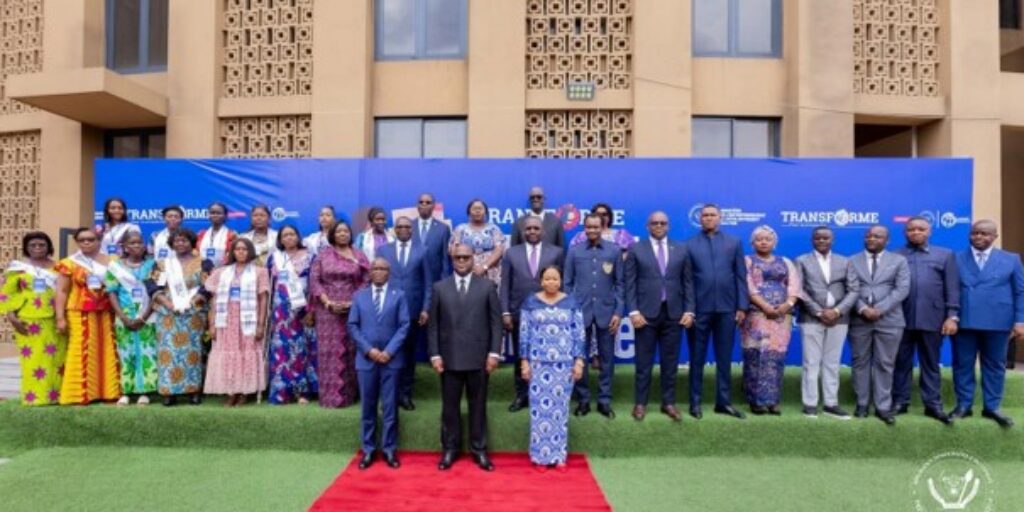
On 31 March 2026, Vese Pinzi Carlin was appointed Ambassador for Positive Masculinity in the Democratic Republic of Congo, a distinction conferred by the Minister of Gender, Family and Children and presented by the President of the Republic. The appointment recognised Carlin’s decade of work challenging harmful gender norms and his central role in shaping the country’s national policy on positive masculinity.
He was one of twelve individuals honoured that day. But the significance of his recognition extends well beyond the ceremony.
Why positive masculinity matters in the DRC
In a country where decades of conflict and displacement have deeply disrupted social structures, transforming ideas about manhood is not only a matter of equality, it is a matter of peace. In communities affected by violence, rigid expectations of masculinity have often been distorted further, associating manhood with dominance and force. These norms sustain gender-based violence and prevent men from healing from trauma and playing constructive roles in their families. Promoting positive masculinity means addressing one of the DRC’s root causes of instability: the intergenerational transmission of violence.
A personal commitment rooted in lived experience
A social science expert and gender equality advocate, Carlin has been dedicated to this work since 2016. His motivation is deeply personal. Having witnessed how harmful models of masculinity fuel violence and family breakdown, he made a deliberate choice to accompany men on a journey of inner transformation, built on the conviction that every man carries the capacity to unlearn violence and relearn care, responsibility, and respect.
“Working with men begins by recognising their inner potential to transform traditional masculinities into positive masculinities, free from gender-based violence,” he says.
That conviction has taken tangible form. His fieldwork with socially marginalised youth has produced documented reductions in community violence, turning at-risk young men into peacebuilders.
From community work to national policy
Carlin’s influence now reaches the highest levels of government. As National President of the Network of Men Engaged for Gender Equality (RHEEG-RDC) and a member of MenEngage DRC, he was among six national experts who drafted the National Strategy for the Promotion of Positive Masculinity (SNPM+), adopted in October 2024, the framework that now guides the country’s efforts to prevent violence and promote gender equity. He also led advocacy that resulted in the establishment of a National Day of Positive Masculinity. His work spans government ministries, civil society, police services, and the armed forces.
The impact has been recognised at the institutional level. As the Minister of Gender, Family and Children stated: “Carlin Vese Pinzi has demonstrated that men’s involvement in promoting gender equality is not a threat to women’s rights — it is an essential driver for building a more equitable and peaceful society. His commitment and leadership have significantly strengthened our national approach to preventing and combating gender-based violence.”
A mandate, not just a title
As Ambassador, Carlin will lead nationwide awareness campaigns, drive implementation of the SNPM+ framework across the DRC’s provinces and mobilise men and boys as active defenders of women’s and girls’ rights.
For MenEngage DRC and the wider MenEngage Africa network, the appointment signals that positive masculinity has moved from a peripheral conversation to a national priority. The real measure of its success, however, will be found not in policy documents or ceremonies, but in the communities and families that live more safely and equitably as a result.


